Bedding · A practical guide
Down Comforter Warmth Explained: Fill Power, Fill Weight, and Seasonal Use
A down comforter’s warmth is not captured by a single number. Fill power describes the loft of its down; fill weight tells you how much of that down is inside. To understand how warm a comforter will feel, you need both—and a few details about its construction, your bedroom, and the person sleeping beneath it.
Published November 24, 2026
There is a particular uncertainty to shopping for a comforter. The labels offer numbers, percentages, and confident adjectives—lightweight, all-season, lofty, warm—while the question behind them remains stubbornly personal: will this feel right at three in the morning, when the room has cooled and one foot has escaped the covers?
Down is valued for its ability to trap still air without adding the weight of a dense blanket. But two comforters filled with down can behave quite differently. One may feel airy and insulating; another, heavy and almost too warm. The difference has much to do with fill power and fill weight, terms that are often presented as if they were competing measures of quality. They are not. They describe different properties, and neither, by itself, is a reliable warmth rating.
A more useful way to choose is to treat the numbers as clues. Consider how much down is in the comforter, how efficiently that down expands, how the shell and stitching hold it in place, and what conditions the comforter will meet at home. A cool bedroom, a warm sleeper, and a preference for one comforter all year may each suggest a different balance.
What fill power tells you
Fill power measures the loft, or expansion, of a given weight of down. In a standardized test, a measured amount of down is allowed to expand under controlled conditions; the volume it occupies is recorded in cubic inches. A higher fill-power number generally means the down can create more loft from less material.
That loft matters because the tiny, branching clusters of down hold pockets of air. Still air slows the movement of heat, helping the comforter retain warmth. Higher-fill-power down can therefore provide substantial insulation while remaining relatively light. It is often associated with a lofty, cloudlike feel, but the number does not tell you how much down has been used or how warm the finished comforter will be.
Think of fill power as an efficiency measure, not a temperature setting. A comforter with a high fill power may be airy and warm, but if it contains a modest quantity of down, it may not provide as much insulation as you expect. Conversely, a comforter with lower fill power can still be quite warm if it contains more fill and is constructed to keep that fill evenly distributed.
There is also a temptation to treat the highest number as automatically best. In practice, the best fill power depends on the intended use, the product’s price, and the sleeper’s preferences. A lofty, lightweight comforter may be appealing to someone who wants warmth without a feeling of weight. Someone who prefers a more substantial covering may care as much about the finished comforter’s feel and construction as the fill-power figure.
What fill weight tells you
Fill weight is the total weight of the down inside the comforter. It is usually listed in ounces or grams. Unlike fill power, it says nothing directly about the loft of each cluster; it tells you how much fill has been used.
All else being equal, more down can create more insulation. But “all else being equal” is doing important work here. A larger comforter naturally requires more fill to achieve a similar feel to a smaller one. A high-fill-power comforter may need less down than a lower-fill-power one to create comparable loft. Differences in baffle design, shell fabric, and the way warmth is described by a manufacturer can further complicate a simple comparison.
For that reason, fill weight is most useful when comparing comforters of the same size and similar construction. If you are looking at a queen-size comforter against another queen-size comforter, the fill weights offer a meaningful point of comparison. If one is a king and the other a twin, the raw numbers are not on equal footing.
Fill weight is also a clue to the comforter’s character. A relatively light fill may produce a less enveloping covering; a heavier one may feel denser and more substantial. But weight is not synonymous with warmth, and a heavy comforter is not necessarily the warmest. A well-lofted, lighter filling can insulate efficiently, while a heavier comforter may deliver the grounded sensation some sleepers prefer.
Why the two numbers belong together
Imagine two comforters with the same fill weight. If one uses higher-fill-power down, it may loft more and trap more air. Now imagine two comforters with the same fill power. The one containing more down may offer greater insulation, though its exact warmth will still depend on the way it is made. In either comparison, one number explains only part of the story.
A helpful first pass is to read fill power as the potential loft of the down and fill weight as the amount of material available to create that loft. Neither translates cleanly into a universal warmth score. Some manufacturers provide a warmth rating or describe a comforter as lightweight, medium-weight, or winter-weight. Those labels can be useful, but they are not always standardized across brands. When available, compare the stated rating with the listed fill power, fill weight, size, and construction rather than treating it as a guarantee.
Look, too, for clear product information. Does the listing identify the size to which the fill weight applies? Does it explain whether its warmth category is intended for a particular season or bedroom temperature? Is the comforter designed as a stand-alone layer or for use inside a duvet cover? Straight answers make a comparison more meaningful than an impressive number presented without context.
Construction: the quiet influence
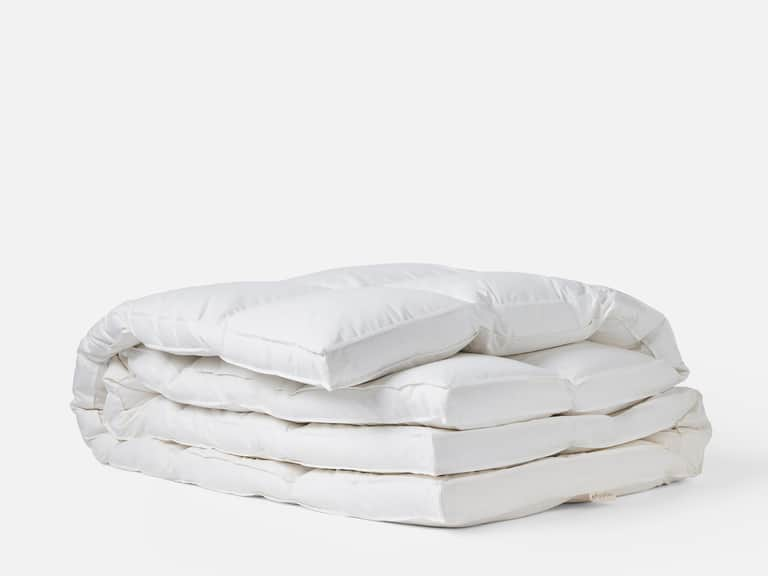
Down must be held in place without being flattened into a uniform sheet. A comforter’s construction affects how evenly the fill spreads and how well it maintains loft. In a box-style construction, fabric walls create compartments that allow the down to expand in separate chambers. Other designs use sewn-through stitching, which joins the top and bottom layers directly. Each approach affects the comforter’s feel, appearance, and ability to distribute insulation.
Seams can create areas with less insulation than the filled sections. Box construction is designed to reduce this unevenness by giving the down room to loft, although the precise result depends on the design and workmanship. A comforter that shifts or develops empty patches may feel cold in some places and overly full in others, regardless of its fill-power rating.
The outer shell has a role as well. A tightly woven fabric helps keep down inside the comforter, while its weight and hand influence how the bed feels. A crisp, light shell may seem cooler or more rustling to one sleeper; a softer, heavier fabric may feel more substantial. The duvet cover adds another layer, and its fabric can change the overall sensation. Percale, sateen, linen, and other materials each have different textures and drape, though none can convert an unsuitable comforter into the right one.
Construction details are less glamorous than a headline fill-power figure. They are also the details most likely to explain why one comforter feels balanced and another does not.
Choose for the room, not just the calendar
Seasonal bedding advice often divides the year into neat categories: a light comforter for summer, a warmer one for winter, and an all-season option in between. Homes are not so tidy. A drafty room in November can feel colder than a well-insulated room in January. Central heating may keep a winter bedroom at a steady, comfortable temperature, while a summer room without air conditioning can remain warm long after sunset.
Start with the conditions where you actually sleep. Consider the usual nighttime temperature, how much the room changes overnight, and whether air conditioning, heating, or an open window affects the bed. A cool bedroom may call for a more insulating comforter, particularly if you tend to feel cold. A consistently warm room may make a lighter comforter more comfortable even in the depths of winter.
Seasonal use is about the sleeping environment rather than the month on the calendar. A comforter labeled “all-season” may be a reasonable choice for a room with moderate temperatures and a sleeper who does not run particularly hot or cold. It may be too warm for someone who overheats in bed, and not warm enough for someone in a chilly room who prefers a single, substantial layer. The label is a starting point—not a verdict.
If your home moves through large temperature swings, layering can be more adaptable than searching for one perfect comforter. A lighter down comforter can be paired with a blanket in colder weather, then used on its own when the room warms. That arrangement lets you adjust warmth without replacing the main bedding each season. The trade-off is an extra layer to manage and launder.
Take your own sleep habits seriously
Two people can share a bed and disagree, with conviction, about the same comforter. One may be comfortable while the other reaches for an extra blanket. That difference is not a failure of the bedding. People vary in their temperature preferences, sleepwear, and sensitivity to warmth; those preferences can matter more than a small difference in fill power.
If you tend to wake feeling hot, be cautious about selecting a comforter solely because its fill-power number is high. Look for a lighter warmth rating or a lower fill weight within the same size and construction, and consider whether the room itself is contributing to the problem. If you often feel cold, a warmer option or a layered system may be more appropriate. If you share a bed, separate blankets can be a practical answer to different comfort needs, even if they interrupt the visual symmetry of a neatly made bed.
Sleepwear and the rest of the bed matter, too. A thick mattress topper, flannel sheets, pajamas, and a closed bedroom door all contribute to the conditions beneath the covers. When a bed feels too warm, the comforter may be only one part of the equation. Changing to lighter sheets or sleepwear can alter the experience without requiring a new comforter.
A simple way to compare options
When two down comforters look similar online, use the following checklist to move beyond the most prominent number:
- Check the size. Compare fill weights only between comforters of the same dimensions, or account for the difference in size.
- Read fill power and fill weight together. One describes loft potential; the other describes the quantity of down.
- Look for a stated warmth level. Treat “lightweight,” “all-season,” and “winter-weight” as useful descriptions, not universal standards.
- Review construction. Find out how the comforter is baffled or stitched, and whether the design is intended to limit shifting or cold spots.
- Consider the shell and cover. Their texture and weight affect the feel of the bed, while a duvet cover adds another layer.
- Match the comforter to your room and habits. Think about nighttime temperature and whether you sleep hot, cold, or somewhere in between.
- Check care instructions. Cleaning requirements and the ability to air or store the comforter conveniently matter over its useful life.
If the information is incomplete, resist the urge to infer a precise warmth level from fill power alone. Ask the seller or manufacturer how the warmth rating is defined, and whether the listed fill weight applies to the size you are considering. A comparison that accounts for uncertainty is more reliable than one built on a single striking specification.
A note on down and alternatives
Down is known for its lightness and loft, but not every sleeper wants it. Some prefer a synthetic fill, while others choose wool, silk, or another material for personal, practical, or ethical reasons. These alternatives have different weights, care requirements, and insulating properties; down’s fill-power scale does not apply to them in the same way.
For down products, consider the information provided about the fill’s composition and sourcing as well as its performance. Labels and certifications can help clarify particular claims, but it is sensible to check what a given standard covers rather than assuming that one mark answers every question. Comfort, warmth, care, and sourcing are distinct considerations. A product can be a good fit on one measure and less suitable on another.
Whatever the filling, a comforter is an intimate piece of equipment. Its success is measured not by how impressive the label looks in a shop, but by whether it supports the kind of sleep you want at home.
The right warmth is a balance
Fill power and fill weight are useful because they make some of a comforter’s hidden qualities visible. Fill power offers a sense of how much loft the down can create; fill weight tells you how much down is present. Read together, they provide a better basis for comparison than either figure alone. Add construction, shell fabric, room temperature, and personal sleep habits, and the choice becomes more legible.
The aim is not to find the biggest number or the most lavish description. It is to find a balance: enough insulation for the coldest ordinary night in your bedroom, without so much warmth that the comforter becomes a nightly negotiation. For some, that balance will be a lofty, relatively light layer. For others, it will be a more substantial comforter, perhaps supplemented by a blanket when winter arrives.
In the end, warmth is experienced rather than calculated. The numbers help you narrow the field; the room and the sleeper decide what feels right. A good comforter does not announce its specifications at midnight. It simply stays comfortable while the night goes on.
Frequently asked questions
Does higher fill power always mean a warmer comforter?
No. Higher fill power indicates that a given quantity of down can loft more efficiently, but it does not tell you how much down the comforter contains. Fill weight, size, construction, and the stated warmth level also matter.
Is a heavier down comforter always warmer?
No. More fill can contribute to insulation, but fill power affects how much loft that fill creates. A heavier comforter may feel more substantial without necessarily being the warmest option in every comparison.
What should I choose for year-round use?
For a room with moderate temperatures, an all-season comforter may suit a sleeper with average warmth preferences. If you sleep hot, live in a warm climate, or experience pronounced seasonal changes, a lighter comforter with an added blanket for colder nights can offer more flexibility.
Can I compare fill weights from different comforter sizes?
Not directly. A larger comforter generally needs more fill to achieve a comparable feel. Compare the same size whenever possible, and use construction and warmth descriptions to provide context.